












The heroes in business memoirs know where they are headed – their markets behave predictably and history politely stays out of the way. Binod Chaudhary’s Made in Nepal: Lessons in Business Building from the Land of Everest belongs to a different tradition. The book is written from the margins – of a small Himalayan nation whose political life has been turbulent, whose institutions fragile, and whose economic imagination has as much been constrained by geography as by governance.
Chaudhary’s story is not merely that of an entrepreneur who built a multinational conglomerate; it is also a narrative about how business survives, adapts, and occasionally flourishes amid political uncertainty, state weakness, and social transformation.
Nepal: Economy in the shadow of politics
For much of the 20th century, Nepal remained economically insular and politically feudal. The Rana oligarchy, followed by decades of absolute monarchy, left little room for capitalistic innovations. Industry was limited, infrastructure skeletal, and private enterprise was viewed with suspicion. Even after the restoration of democracy in 1990, Nepal entered a prolonged phase of instability: coalition governments, policy paralysis, and eventually a decade-long Maoist insurgency that shook the foundations of the state.
It is within this landscape that the Chaudhary Group grew. Made in Nepal is attentive to this context, even when it does not foreground it explicitly. Chaudhary reminds us that building a business in Nepal was never merely an economic act; it was also a negotiation with politics, bureaucracy, labour unrest, border dependencies, and a chronic shortage of capital. Unlike entrepreneurs in more stable economies, he had to think not just about markets but about survival.
What distinguishes Chaudhary’s account is his refusal to romanticise adversity. Political instability is seen as a constraint that demands patience, diversification, and long-term thinking. The book suggests that Nepali entrepreneurs learned resilience not because they wanted to, but because they had no alternative.
The Chaudhary Group began, like many South Asian business houses, as a trading concern. Chaudhary narrates this phase with restraint, resisting the temptation to mythologise humble beginnings. Instead, he focuses on a crucial shift: the move from trading to manufacturing. This transition, he suggests, was both economic and philosophical. Manufacturing anchored the business in Nepal, created employment, and allowed value to be added locally rather than exported abroad.
The success of Wai Wai noodles, now a household name across South Asia and beyond, is often cited as a case study in brand building. In Made in Nepal, it becomes something more: an example of how a local product, priced affordably and marketed intelligently, could transcend borders. Chaudhary is careful to emphasise systems over serendipity. Distribution networks, supply-chain discipline, and cultural sensitivity mattered as much as the taste of the instant noodles.
What emerges is a portrait of capitalism that is pragmatic rather than speculative. Expansion into hospitality, cement, telecom, and finance is explained not as empire-building but as diversification born of necessity. In a volatile economy, putting all one’s capital in a single sector could be quite reckless.
One of the quieter strengths of Made in Nepal lies in its treatment of the family business. In South Asia, family enterprises are often criticised for opacity and nepotism, yet they remain the backbone of the regional economy. Chaudhary does not deny the tensions inherent in such structures. Instead, he reflects on the challenge of professionalisation, how to retain familial trust while embracing institutional discipline.
Here, the book aligns with a broader South Asian concern: the absence of strong institutions. In Nepal, where the state has frequently faltered, businesses have often had to create their own systems of governance, accountability, and continuity. Chaudhary’s insistence on professional management, succession planning, and global best practices can be read as an attempt to build islands of institutional stability in an otherwise uncertain environment.
This is capitalism with a civic instinct. Not overtly ideological, but conscious of its social embeddedness.
Unlike many business memoirs, Made in Nepal is notably restrained in tone. Chaudhary avoids the language of conquest. There is little chest-thumping about market domination or wealth accumulation. Instead, the emphasis is on endurance. Success, in this telling, is not a straight ascent but a series of adjustments, some strategic, others instinctive.
This restraint may disappoint readers seeking dramatic revelations or confessional excess. Yet it is precisely this sobriety that gives the book its credibility. Chaudhary understands that in societies like Nepal, wealth exists in close proximity to poverty, and that visibility invites scrutiny. His reflections on philanthropy and social responsibility, though brief, are framed as obligations rather than benevolence.
Nepal and the possibility of modernity
At a deeper level, Made in Nepal poses a question that extends beyond business: can a small, landlocked, politically fragile nation participate meaningfully in global modernity? Chaudhary’s answer is cautiously affirmative. He believes that scale need not determine ambition, and that national identity need not be a liability in global markets.
The book implicitly challenges a long-standing narrative that sees Nepal primarily through lenses of tourism, spirituality, or tragedy. Here is another Nepal: entrepreneurial, adaptive, outward-looking. Not without flaws, but unwilling to be defined by limitation alone.
A reviewer must also attend to silences. Made in Nepal does not deeply interrogate questions of labour, inequality, or environmental impact. Nor does it critically examine the broader relationship between big business and the Nepali state. These omissions are understandable in a personal narrative, but they remain areas where future scholarship and reportage must tread.
Yet to fault the book for not being what it never claimed to be would be unfair. This is not a sociological treatise or a political economy of Nepal. It is, instead, a practitioner’s reflection, valuable precisely because it emerges from within the system rather than outside it.
In the end, Made in Nepal matters not because it offers universal business formulas, but because it documents a particular journey shaped by place and time. It reminds us that capitalism is not monolithic; it acquires different textures in different societies. The capitalism Chaudhary describes is cautious, relational, and deeply attentive to risk, not the brash disruptor of Western myth.
For readers in South Asia, the book offers something rare: a serious business memoir that neither apologises for success nor detaches itself from social reality. For readers elsewhere, it serves as a reminder that some of the most instructive stories of enterprise are unfolding far from the familiar centres of power.
Binod Chaudhary’s life may be exceptional, but the questions his book raises about resilience, institutions, and the moral weight of enterprise are widely shared. Made in Nepal is, finally, not just a book about business. It is a book about making something durable in a world that does not stand still.
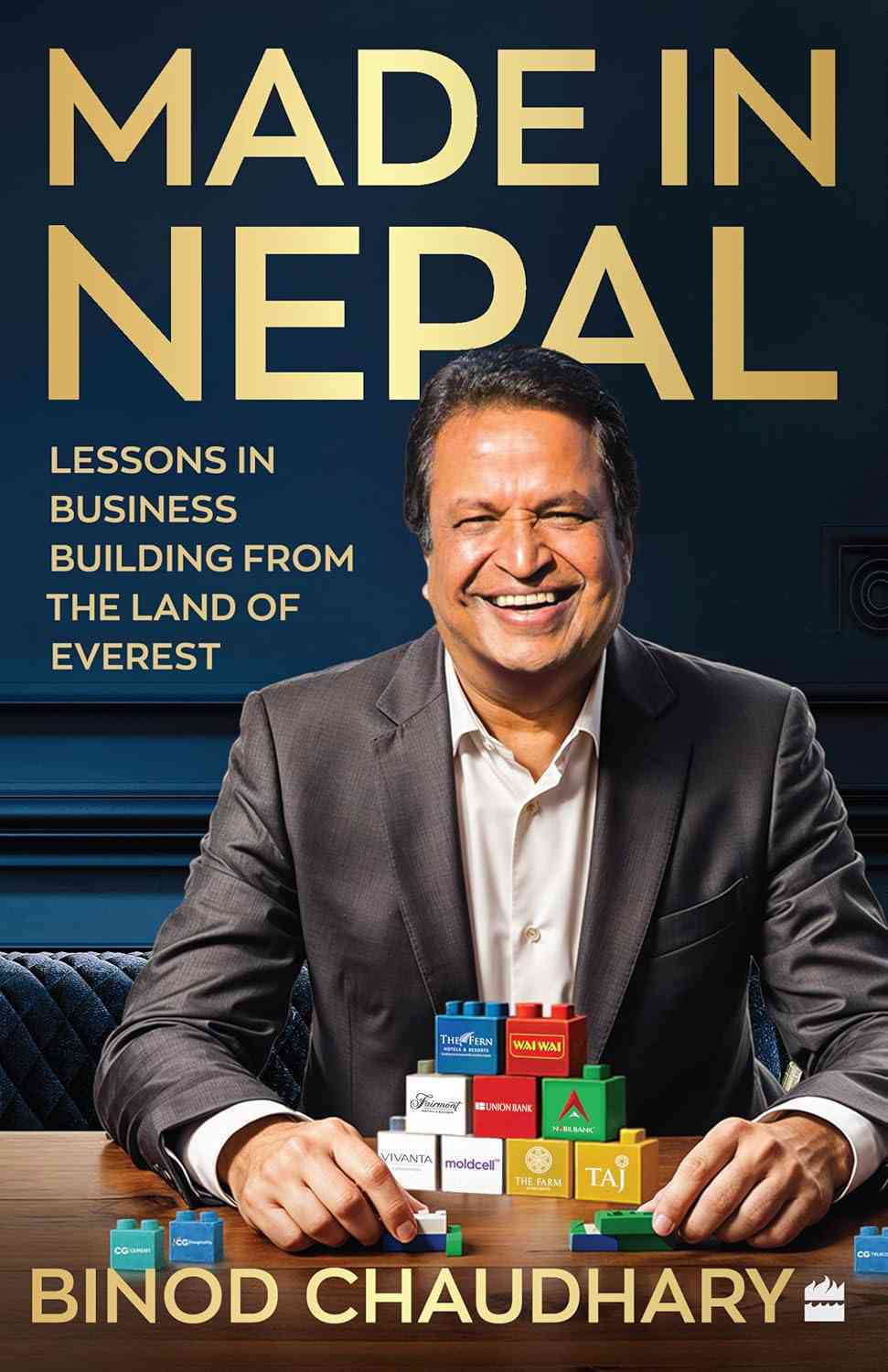
Made in Nepal: Lessons in Business Building from the Land of Everest, Binod Chaudhary, HarperCollins India.
